Please be aware that scammers sometimes approach participants claiming to be able to provide accommodation and asking for credit card details. Do not give this information to them! If you are in any doubt about the legitimacy of an approach, please get in contact with the organizers.
Venue
Nordita, Stockholm, Sweden
Scope
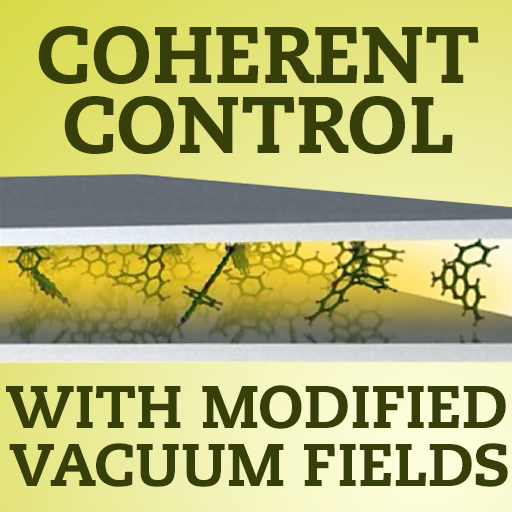
Coherent control of molecular dynamics by dressing potential energy surfaces with light has an enormous potential for photochemical applications in light harvesting, energy storage, opto-electronic and communication. In recent years this concept has been extended to modified vacuum fields as they are created by photonic structures that can confine specific light modes, such as optical cavities or nano-plasmonic structures. The increased interaction between those confined light modes and the molecules can lead to the formation of new hybrid light-matter states called polaritons. These polaritons are coherent superpositions of excitations of the molecules and of the light modes. The hybridization between light and matter not only delocalizes the excitation over many molecules but also changes their potential energy surfaces, and thus could be a new way to control chemistry, change optical material properties, and control energy transfer. Manipulating molecules with cavities requires a complete understanding of how the interaction with confined light affects the molecular dynamics. Thus, to unlock the full potential of manipulating chemistry with photonic structures, we urgently need a unified theoretical description of the strongly coupled light matter interaction that is sufficiently accurate to systematically design optical nano-structures for selectively altering reactivity. The new theoretical description needs to go significantly beyond the state of the art, as it needs to take into account the quantum nature of light. Therefore, the integration of the new theoretical framework into existing electronic structure and molecular dynamics methodologies will be a tremendous challenge and requires an interdisciplinary approach. With the workshop, we intend to overcome this challenge by bringing together researchers who are at the forefront of this field, either in theory or experiment. Ultimately, we expect to not only further our insights into strong light-matter coupling and its applications, but also to establish the new state of the art in understanding and predicting the effects of a modified vacuum on chemical reactivity.
Themes and preliminary program schedule
We are planning a full 3 day program from May 4th to May 6th We thus recommend planning arrival on May 3rd and departure on May 7th.
Invited speakers
| Henrik Koch |
| Karl Borjesson |
| Timur Shegai |
| Mark Kamper Svendsen |
| Antonio Fernández Domínguez |
| Tönu Pullerits |
| Anton Zasedatelev |
| Tao Li |
| Johannes Feist |
| Norah Hoffmann |
| Anael Ben-Asher |
| Oriol Vendrell |
| Agnes Vibok |
| Marit Fiechter |
| Tal Schwartz |
| Remi Avriller |
| Dominik Sidler |
| Blake Simpkins |
| Stefano Corni |
Accommodation
Nordita has reserved a block rooms at the following hotel:
Elite Hotel Arcadia | 20 Superior double room for single use - For details and reserving a room, click here. Last day to book your room is 4th of April. All reservations, date adjustments and/or cancellations are to be made by the interested participant directly with the hotels.
Please be aware that scammers sometimes approach participants claiming to be able to provide accommodation and asking for credit card details. Do not give this information to them! If you are in any doubt about the legitimacy of an approach, please get in contact with the organizers.
Application/Registration
Registration to be considered for on-site participation will close April 19th. Registrants will receive an on-site/remote participation confirmation from the organizers after this date.
Sponsored by: