Speaker
Description
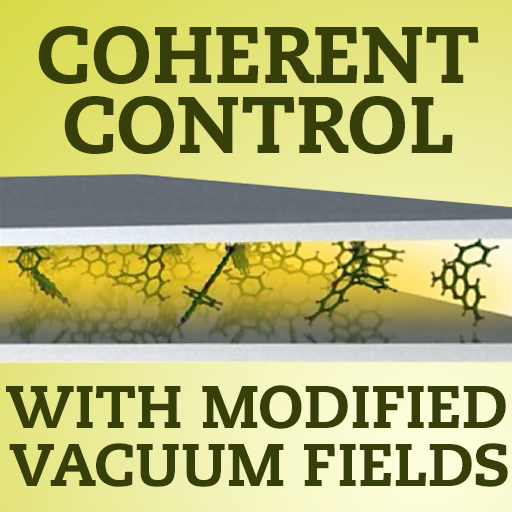
Strong light–matter coupling in optical microcavities offers a promising route to manipulate molecular processes by engineering the electromagnetic vacuum field.(1,2) In this work, we propose to investigate polariton-mediated electron transfer in donor–acceptor systems, using BODIPY based donor and TCNQ acceptor embedded in silver Fabry–Pérot microcavities. This platform is designed to selectively hybridize donor excitations into polaritonic states while maintaining localized acceptor states, enabling controlled exploration of non-equilibrium energy transfer pathways.(3) The BODIPY donor will be designed to homogeneously fill the entire cavity to ensure strong coupling while the spatial distribution of the TCNQ acceptor will be varied, enabling investigation of the effects of placing the reaction at electric field nodes and antinodes.
We aim to employ angle-resolved reflectivity measurements to establish the formation of upper and lower polariton branches and to quantify the strength of light–matter coupling. Ultrafast transient absorption spectroscopy will be used to track population dynamics and probe potential modifications to donor-to-acceptor transfer under strong coupling conditions. By tuning cavity detuning and coupling strength, we seek to control spectral overlap and the energetic driving force for charge separation.
This approach will allow us to investigate whether polaritonic states enable new pathways for electron transfer that are inaccessible in conventional donor–acceptor systems governed by short-range interactions. More broadly, this work aims to establish modified vacuum fields as a tool for influencing molecular dynamics, opening new directions for coherent quantum control in chemical systems.
1) T. W. Ebbesen, Acc. Chem. Res., 2016, 49, 2403–2412.
2) Bhuyan, R.; Mony, J.; Kotov, O.; Castellanos, G. W.; Gómez Rivas, J.; Shegai, T. O.; Börjesson, K., Chem. Rev., 2023, 123, 10877–10919.
3) Rashidi, K.; Michail, E.; Salcido-Santacruz, B.; Paudel, Y.; Menon, V. M.; Sfeir, M. Y., Nat. Nanotechnol., 2025, 20, 1618–1624.