OKC colloquia
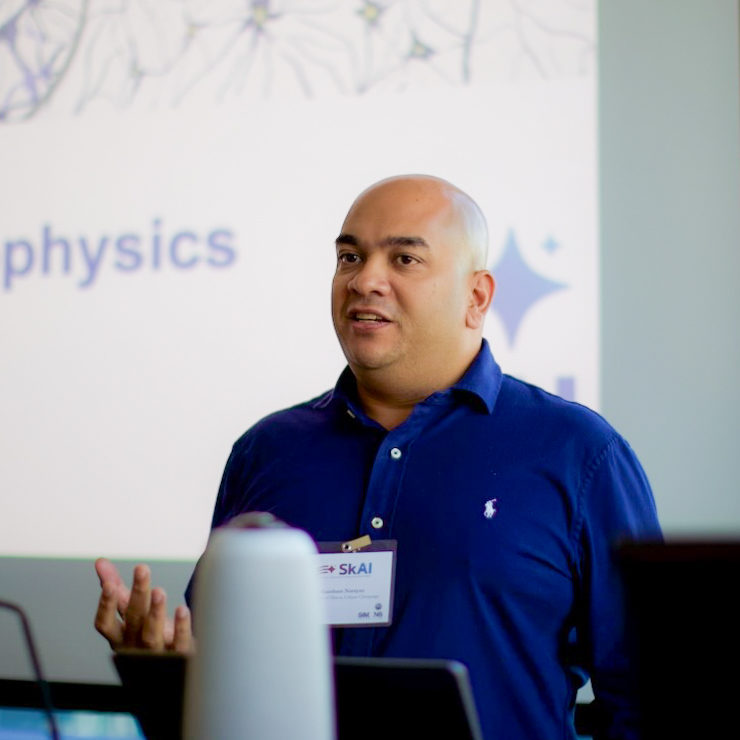
Gautham Narayan; The Vera C. Rubin Observatory: A Cosmic Movie Begins
→
Europe/Stockholm
FB51 (AlbaNova Main Building)
FB51
AlbaNova Main Building
Description
The NSF-DOE Vera C. Rubin Observatory in Chile has begun operations and will soon scan the entire southern sky every three nights for a decade. The Legacy Survey of Space and Time will discover millions of asteroids, millions of supernovae and other transients, and assemble the largest catalog of galaxies yet.
I will give a current snapshot of Rubin from my recent visit to the summit: where the telescope stands today, what still has to happen before the first data release, and the observing conditions the survey will face. I will place Rubin in the context of the surveys that preceded it and alongside its partners, NASA's Roman Space Telescope and ESA's Euclid mission. I will then sketch the science LSST will transform — the solar system, the Milky Way, galaxy evolution, transients, dark matter, and dark energy — and close on the role of astronomical AI foundation models in analyzing surveys at this scale.
About the speaker:
Gautham Narayan is a Professor of Astronomy at the University of Illinois Urbana-Champaign and Deputy Director for Astrophysics Research at the NSF-Simons SkAI Institute. He is Spokesperson for the LSST Dark Energy Science Collaboration and PI of the NSF SCIMMA project for multi-messenger cyberinfrastructure. His research spans supernova cosmology and the Hubble tension, rare and exotic transients, and foundation models for time-domain astrophysics, with current work focused on dark energy constraints from the combined Rubin, Roman, and Euclid surveys.
In the OKC: Monday-Friday, May 11-15, in the CoPS A5 corridor
Organised by
Ariel Goobar (speaker host), Alex Burgman & Azi Fattahi (OKC colloquium coordinators)