-
Prof. Edo Berger (Harvard University)10/08/2011, 14:00Stars more massive than about 8 times the mass of the Sun end their lives in cataclysmic explosions: supernovae and gamma-ray bursts. In recent years targeted and blind transient surveys have expanded the range of potential outcomes, including potentially non-destructive eruptions on the path to the eventual explosion and highly-luminous events that may require a new range of progenitor...Go to contribution page
-
Mr Morgan Fraser (Queens University Belfast)10/08/2011, 14:30In the last fifteen years, searches for the progenitors of core-collapse supernovae in archival Hubble Space Telescope images have yielded progenitor candidates for ~10 nearby supernovae, and upper limits on the luminosity and mass for a further ~20. In this talk, I discuss recent results from ongoing progenitor searches. In particular, I focus on some of the open questions in progenitor...Go to contribution page
-
Dr Andrea Pastorello (Universita' di Padova)10/08/2011, 15:00A number of supernovae has been discovered in recent times showing weird observed properties. A few of them are extremely sub-luminous, others are among the brightest stellar explosions ever observed. In this review I present photometric and spectroscopic data of some of the most astonishing unusual transients, and outline what we currently know on the nature of their progenitor stars.Go to contribution page
-
Jesper Sollerman (Stockholm University)10/08/2011, 16:00I will make a quick review of the connection between Supernovae and Gamma-Ray Bursts, from an observers perspective. I plan to run through the history of GRBs with a special eye to the SN associations, and try to include also some of the more recent issues and developments.Go to contribution page
-
Prof. Alexander Heger (University of Minnesota, Twin Cities)10/08/2011, 16:30Recent progress in observations have allowed us to now find an overwhelming collection of observational supernova data including a wealth of different classes and marvelous detail in part. But how do they connect with our understanding of the underlying engine, and what stars are responsible for each of them? Theoretical models, on the other hand, also provides a wide variety of model,...Go to contribution page
-
Dr Avishay Gal-Yam (Weizmann Institute Of Science)10/08/2011, 17:00The theoretical prediction that stars that develop heavy oxygen cores will become pair-unstable and explode has been made many decades ago. Yet, for many years, no examples of such explosions were found, and it was often conjectured that stars massive enough to explode in this manner may only exist at very high redshifts (population III stars). In recent years several luminous supernova...Go to contribution page
-
Dr Thierry Foglizzo (CEA-Saclay, France)10/08/2011, 17:30Massive stars end their life with the gravitational collapse of their core and the formation of a neutron star. Their explosion as a supernova depends on the revival of a spherical accretion shock, located in the inner 200km and stalled during a few hundred milliseconds. Numerical simulations suggest that an asymmetric explosion is induced by a hydrodynamical instability named SASI....Go to contribution page
-
Mr itay Rabinak (Weizmann institute of science)10/08/2011, 17:35We derive a simple approximate model describing the early, up to a few days, UV/optical supernova emission, which is produced by the expansion of the outer hundredth solar mass of the shock-heated envelope, following the shock breakout and preceding the optical emission driven by radioactive decay. Our model includes an approximate description of the time dependence of the opacity...Go to contribution page
-
Dr Rhaana Starling (University of Leicester)10/08/2011, 17:40A growing number of long Gamma-Ray Bursts are indisputably associated with core-collapse supernovae, discovered through optical spectroscopy and/or photometry of the GRB afterglow. Three such bursts show evidence of a thermal component in the early X-ray afterglow emission, claimed by some to be a signature of supernova shock breakout. This component could equally be attributed to central...Go to contribution page
-
Mr Ondrej Pejcha (Department of Astronomy, Ohio State University)10/08/2011, 17:45The mechanism of core-collapse supernovae is unknown. Despite considerable effort, most simulations of supernovae are not successful, and it has proven difficult to revive the stalled accretion shock, particularly for more massive stellar progenitors. Although it is known that the stalled accretion shock turns into explosion when the neutrino luminosity from the collapsed core exceeds a...Go to contribution page
-
Patrick Slane (Harvard-Smithsonian Center for Astrophysics)10/08/2011, 17:50As a pulsar wind nebula evolves inside its host supernova remnant, its gamma-ray emission becomes increasingly brighter due to the buildup of energetic particles injected by its pulsar. When the SNR reverse shock collides with the PWN, the resulting increase in the magnetic field results in rapid synchrotron losses, modifying the particle spectrum of the nebula. Gamma-ray observations of...Go to contribution page
-
Dr Dovi Poznanski (UC Berkeley & LBL)10/08/2011, 17:55Dust extinction is generally the least tractable systematic uncertainty in astronomy, and particularly in supernova science. Often in the past, studies have used the equivalent width of Na I D absorption measured from low-resolution spectra as proxies for extinction, based on tentative correlations that were drawn from limited data sets. We have recently shown, based on 443...Go to contribution page
-
Dr George Sonneborn (NASA Goddard Space Flight Center)10/08/2011, 18:00The nature and quantity of dust produced in supernovae (SNe) is still poorly understood. Recent IR observations of freshly-formed dust in supernova remnants (SNRs) have yielded significantly lower dust masses than predicted by theoretical models and observations high-redshift galaxies. The Crab Nebula's pulsar wind is thought to be sweeping up freshly-formed SN dust along with the SN...Go to contribution page
-
Dr Ross Church (Lund University)10/08/2011, 18:05The presence of a binary companion can have a significant effect on a supernova explosion. Mass transfer affects the evolution of the stars; a massive star may transfer so much mass that it fails to explode as a supernova, whilst conversely an accreting lower-mass star may gain enough material to cause it to explode. Massive stellar cores in close binaries can be spun up by...Go to contribution page
-
Ms Io Kleiser (University of California at Berkeley)10/08/2011, 18:10The vast majority of Type II supernovae (SNe) are produced by red supergiants (RSGs), but SN 1987A revealed that blue supergiants (BSGs) can produce members of this class as well, albeit with some peculiar properties. This best studied event revolutionized our understanding of SNe, and linking it to the bulk of Type II events is essential. We present here optical photometry and...Go to contribution page
-
Mr Takashi Moriya (IPMU, University of Tokyo)10/08/2011, 18:15We investigate the effect of non-steady dense mass loss on the shock breakout in dense wind. We found that the effect of the dense wind from non-steady mass loss can account for two types of interaction-powered luminous supernovae: 06gy-like LSNe which show the narrow emission lines from wind and 08es-like LSNe which do not show them.Go to contribution page
-
Dr Salvatore Orlando (INAF - Osservatorio Astronomico di Palermo)10/08/2011, 18:20During the evolution of SNRs, Rayleigh-Taylor (RT) instability develop at the contact discontinuity between the ejecta and the shocked interstellar medium (ISM). The nonlinear instability evolves, giving rise to a turbulent structure with preferentially radial components, the so-called RT fingers. Current multi-dimensional models of SNRs describe the development of these structures....Go to contribution page
-
Francesco Taddia (Stockholm University, department of Astronomy)10/08/2011, 18:25Supernova 1987A revealed that a blue supergiant (BSG) can end its life as a core-collapse supernova (SN). Such objects show peculiar properties distinguishing them from ordinary Type IIP SNe, whose progenitors are believed to be red supergiants. A similarity among 1987A-like events include a long rise to maximum and peak luminosities which are fainter than Type IIP SNe and mainly powered...Go to contribution page
-
Dr Omer Bromberg (Racah Institute of Physics, The hebrew University, Jerusalem, Israel)10/08/2011, 18:30According the Collapsar model long GRBs (LGRBs) arise during the collapse of a massive star and involve the emergence of a relativistic jet through the envelope of the exploding star. This model naturally explains the links between LGRBs and SNe, such as the the association of half a dozen LGRBs with broad-line Ic SNe. However, a closer look at this association reveals that four out of...Go to contribution page
-
Dr Patrick BLOTTIAU (CEA, DAM, DIF, Arpajon, France and Laboratoire Univers et Théories, Observatoire de Paris, Meudon, France)10/08/2011, 18:35A complete description of the core-collapse supernova mechanism requires an appropriate treatment of both the hydrodynamics and the microphysics. Indeed, despite the crucial role played by hydrodynamics (e.g. hydrodynamical instabilities, rotation, convection or General Relativistic effects), to produce type II supernovae explosions, the influence of nuclear physics inputs on the outcome...Go to contribution page
-
Dr Tabetha Hole (East Tennessee State U.)10/08/2011, 18:40Constraining the structure and asymmetries within supernova (SN) ejecta is of great importance to understanding the explosion mechanism and for constructing better models of SN feedback mechanisms. SN forbidden line profiles at later times, when the ejecta is optically thin in the continuum, provide a potential diagnostic of densities and the distribution of individual ionic species...Go to contribution page
-
Dr Bernhard Mueller (MPA Garching)10/08/2011, 18:45The collapse of an iron core to a neutron star and the subsequent supernova explosion are among the greatest challenges in computational astrophysics due to the complex interplay of multi-dimensional hydrodynamics, neutrino transport, and strong-field gravity. Due to the compactness of the newly-born proto-neutron star and the occurrence of high velocities (up to ~0.3c), general...Go to contribution page
-
Dr Rino Bandiera (INAF - Osservatorio Astrofisico di Arcetri)10/08/2011, 18:55Bamba et al. (2010) used deep X-ray observations, with Chandra and Suzaku, to estimate the sizes of faint and old Pulsar Wind Nebulae (PWNe). They found a steady increase in size with the nebular age, up to ages of about 10^5 yr. Their conclusion was that these PWNe keep expanding up to large ages, in apparent contradiction with the idea that a reverse shock from the associated...Go to contribution page
-
Dr Yudai Suwa (Kyoto University)10/08/2011, 19:00Core-collapse supernovae are violent explosion of massive stars at their end of life. The standard model of the supernova explosion is so-called ``delayed explosion scenario'', in which the neutrino heating plays an important role. In order to investigate whether this model works properly, we must solve raditation hydodynamic equations incorporating the neutrino radiative transfer with...Go to contribution page
-
Dr Leloudas Giorgos (Dark cosmology Centre)10/08/2011, 19:05Stripped-envelope core-collapse SNe are supposed to result from the explosions of stars that have lost their outer hydrogen layers but the exact nature of their progenitor and (possible) companion stars remains unknown. By comparing their locations to those of WR stars we show that they are indeed compatible. Furthermore, SN Ib locations are more closely related to those of WN stars,...Go to contribution page
-
Dr Tea Temim (NASA Goddard Space Flight Center / ORAU)10/08/2011, 19:10We present deep Chandra observations and Spitzer Space Telescope infrared (IR) spectroscopy of the shell in the composite supernova remnant (SNR) Kes 75. The remnant is composed of a central pulsar wind nebula (PWN) and a bright partial shell in the South that is visible at radio, IR, and X-ray wavelengths. The X-ray emission from the shell is dominated by a two-component thermal model...Go to contribution page
-
Dr Gaston Folatelli (IPMU, University of Tokyo)10/08/2011, 19:15We present a detailed study of the Type Ib/c SN 2010as based on optical and near-infrared imaging and spectroscopy, plus radio observations. The data span from about two weeks before to about 150 days after maximum light. SN colors and spectra indicate this object suffered considerable reddening by dust. Intermediate resolution X-Shooter spectra cover the time of maximum light and show...Go to contribution page
-
Dr Shin-ichiro Fujimoto (Kumamoto National College of Technology)10/08/2011, 19:20We examine explosive nucleosynthesis during neutrino-driven, aspherical supernova (SN) explosion aided by standing accretion shock instability, based on two-dimensional hydrodynamic simulations of the explosion of 15-40$M_\odot$ stars with zero metallicity. The magnitude and asymmetry of the explosion energy are estimated with the simulations, for a given set of neutrino luminosities...Go to contribution page
-
Dr Jennifer Hoffman (University of Denver)10/08/2011, 19:25Supernovae of all types are known to be polarized, and many display complex line polarization effects that evolve over time as the supernova evolves. Such behavior reveals details of the clumpy nature of the ejecta, as well as illuminating the characteristics of the circumstellar material lost by the star in its pre-supernova evolution. With the aid of diagnostic tools developed through...Go to contribution page
-
Dr Melina Bersten (IPMU)10/08/2011, 19:30We present a model for the Type Ib SN 2008D, associated with the X-ray Flash 080109, which assumes a double-peaked 56Ni distribution. This assumption is fundamental to explain the plateau observed in the light curve a few days after the explosion. The presence of this high-velocity radioactive material may be caused by the formation of jets during the explosion. We briefly discuss the...Go to contribution page
-
Ms Eveline Helder (Pennsylvania State University)10/08/2011, 19:35The evidence for supernova remnants as the main sources for Galactic cosmic rays has accumulated over the past decades. However, the physics of the acceleration mechanism is still unclear. In particular, there is a lack of empirical data to test current shock acceleration models. RCW 86 is an excellent source to test these models, as the shock velocities of the remnant vary by an order...Go to contribution page
-
Mr Jason Dittmann (Harvard University)10/08/2011, 19:40We present time series radio data of the type Ic supernova SN 2004C taken with the VLA from January 2004 through April 2009 at 4.9 GHz, 8.5 GHz, 15 GHz, and 22 GHz. We also present 3 epochs of Chandra data taken 110, 170, and 1150 days after the initial explosion. We model our radio data for each epoch with a synchrotron self absorbed spectrum, and apply the dynamical model of...Go to contribution page
-
Ms Sarah Wellons (Harvard University)10/08/2011, 19:45We present extensive radio observations of the nearby Type Ibc supernovae (SNe Ibc) 2004cc, 2004dk, and 2004gq spanning $\Delta t\approx 8-1800$ days after explosion. Using a dynamical model developed for synchrotron emission from a slightly decelerated blastwave, we estimate the velocity and energy of the fastest ejecta and the density profile of the circumstellar medium. The...Go to contribution page
-
Ms Kate Alexander (Harvard-Smithsonian Center for Astrophysics)10/08/2011, 19:50We present radio observations of the type Ic supernova 1994I, reanalyzed as part of a search for radio transients in M51 conducted using archival data from the Very Large Array. The data includes a detailed 4.9 GHz light curve of SN 1994I and three spectra of this object from epochs on April 10, May 4, and August 8, 1994, each spanning frequencies of 1.5-22.5 GHz. We find that the...Go to contribution page
-
Prof. Adam Burrows (Princeton University)11/08/2011, 08:30Core-collapse supernovae are a puzzle that has taxed theorists and computational science for half a century. Such explosions are the source of many of the heavy elements in the Universe and the birthplace of neutron stars and stellar-mass black holes. However, determining the mechanism of explosion remains the key goal of theory. Recently, using sophisticated numerical tools and...Go to contribution page
-
John Blondin (North Carolina State University)11/08/2011, 09:00A core-collapse supernova event begins with a nearly spherical hydrodynamic implosion of the core of a massive star and ends with a hydrodynamic explosion as an aspherical shock wave expands through the stellar envelope. The breaking of spherical symmetry is both critical for driving the explosion as well as determining the characteristics of the supernova. The origin of asymmetry may...Go to contribution page
-
Dr H.-T. Janka (MPI, Garching)11/08/2011, 09:30The talk will review 2D and 3D modeling of core-collapse supernova explosions by the Garching group. It will address the question of the explosion mechanism and the role of relativistic effects, of the neutron star equation of state, and of dimensionality (2D vs. 3D) in this context. Observational consequences of the explosion mechanism will also be discussed.Go to contribution page
-
F. Thielemann (Dept. of Physics, University of Basel)11/08/2011, 10:30Supernovae are observationally characterized by their lightcurves, spectra, late time radioactivities in remnants and their integrated contribution to chemical evolution, witnessed in observations of old stars. We will highlight open questions with respect to nucleosynthesis contributions from core collapse supernovae. While many aspects of intermediate mass (alpha) elements...Go to contribution page
-
Prof. Ken Nomoto (IPMU, University of Tokyo)11/08/2011, 11:00The properties of supernovae associated with GRBs & XRFs, and some other related supernovae are summarized. Discussion includes the possible connection to the unusual supernovae, such as extremely luminous and extremely faint supernovae. The abundance patterns predicted in their nucleosynthesis are compared with those of metal-poor halo stars, DLAs, and other related objects.Go to contribution page
-
Dr Ehud Nakar (Tel Aviv University)11/08/2011, 13:00Observations of SNe light at early times can open a window to a wealth of information on the progenitor system and the explosion itself. I will present the theoretical expectation of that emission, starting at the shock breakout, through the planar phase and into at the spherical phase, until recombination and/or radioactive decay start playing a role. I will discuss separately Newtonian...Go to contribution page
-
Dr Maryam Modjaz (Columbia University)11/08/2011, 13:30Stripped-envelope core-collapse supernovae (i.e., SNe of Type IIb, Ib, Ic and broad-lined Ic) are supernovae whose massive progenitors have been stripped of progressively larger amounts of their hydrogen and helium envelopes. While the SNe Ic-bl associated with long Gamma Ray Bursts (GRBs) have been studied in detail, the full range of properties of normal or broad-lined SNe is not...Go to contribution page
-
Mrs Maximilian Stritzinger (Stockholm University)11/08/2011, 14:00The Carnegie Supernova Project obtained detailed optical (uBgVri) and near-IR (YJHKs) light curves of 35 Type Ib/c and Type IIb supernova. This data set is particularly well-suited to explore color relations over a broad wavelength range, and may offer new ways to accurately estimate host galaxy extinction. I will present the photometric sample and results from an initial analysis of the...Go to contribution page
-
Dr Nikolai Chugai (Institute of astronomy, Russian. Ac. Sci.)11/08/2011, 14:30Type IIn supernovae (SN IIn) is highly diverse and badly understood class with a common feature: they show narrow emission lines indicative of a dense circumstellar matter (CSM). The narrow emission lines could originate either from the undisturbed circumstellar gas excited by X-ray/ultraviolet radiation or from shocked circumstellar clouds. In most SNe IIn the total luminosity is fully...Go to contribution page
-
Dr Ori Fox (NASA/GSFC/ORAU)11/08/2011, 15:30A relatively small number of CCSNe have been observed to exhibit late-time (>100 d) infrared emission from dust over the past 30 years. Since the launch of Spitzer (and now even Herschel), the community has had the capability to probe supernova- associated dust at mid- and far-infrared wavelengths. Combined with ground-based optical and NIR observations, these data have provided...Go to contribution page
-
Dr Isabelle Cherchneff (Universitaet Basel)11/08/2011, 16:00Cosmic dust forms in the circumstellar environments of evolved stars with low and high masses because the synthesis of dust requires high gas densities and temperatures. Supernovae are one of these environments and form dust in their ejecta a few months after their explosion. The harsh physical conditions met in the ejecta and the absence of hydrogen hamper the production of complex...Go to contribution page
-
Dr Oliver Krause (Max Planck Institute for Astronomy)11/08/2011, 16:30Young Galactic supernova remnants are unique laboratories for supernova physics. Due to their proximity they provide us with the most detailed view of the outcome of a supernova. However, the exact spectroscopic types of their original explosions have been undetermined so far - hindering to link the wealth of multi-wavelength knowledge about their remnants with the diverse population of...Go to contribution page
-
Dr Luc Dessart (Laboratoire d'Astrophysique de Marseille)11/08/2011, 17:00I will present a new modeling approach that simultaneously computes spectra and light curves and takes into account line blanketing, departures from Local Thermodynamic Equilibrium, time dependent terms in the radiative-transfer, energy, and statistical-equilibrium equations, as well as non-thermal processes associated with radioactive decay. Combined with hydrodynamical inputs of SN...Go to contribution page
-
Roger Chevalier (Univ. of Virginia)12/08/2011, 08:30Recent ideas related to supernova interaction with their surroundings will be discussed. Attention will be given to the case of very dense surroundings.Go to contribution page
-
Dr Vikram Dwarkadas (University of Chicago)12/08/2011, 09:00Stellar wind mass-loss and photo-ionization can modify the ambient medium around massive stars during their evolution. Using numerical simulations, we discuss the formation of the circumstellar medium (CSM) around massive stars, and the evolution of supernova shock waves within this medium. The shock-CSM interaction heats up the gas to X-ray emitting temperatures. The output from numerical...Go to contribution page
-
Prof. Alicia Soderberg (Harvard University)12/08/2011, 09:30For centuries, supernovae have been studied primarily in the visual band thanks to their strong optical emission that dominates the bolometric luminosity on timescales of weeks following the explosion. At the same time, some of the most profound advances in our understanding of supernovae have been made possible through observations at other wavelengths. Here I will review the unique...Go to contribution page
-
Prof. Robert Kirshner (Harvard University)12/08/2011, 10:30The Hubble Space Telescope programs dubbed SINS and SAINTS have been underway since the launch of HST. The angular resolution of HST allows us to image the many different parts of the supernova as it becomes a remnant, and the spectra, especially in the UV, have helped us understand its chemistry and physics. SN 1987A was the best-observed supernova and is now becoming the...Go to contribution page
-
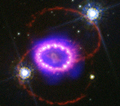
Prof. Peter Lundqvist (Dept. of Astronomy, OKC, Stockholm)12/08/2011, 11:00The structure of the circumstellar medium around SN 1987A poses a challenge to our understanding of mass loss from massive stars. I will review what is known about the three rings around the supernova, as well as other gas close to it. I will also discuss how the rings have been excited, and what we can learn from them about the supernova shock breakout and the ejecta/ring interaction....Go to contribution page
-
Prof. Sangwook Park (University of Texas at Arlington)12/08/2011, 13:00SN 1987A has been monitored by several X-ray missions such as Chandra, XMM-Newton, ROSAT, Suzaku, and Swift. Now in the phase of young supernova remnant (SNR), X-ray emission from 1987A is dominated by radiation from the shock interacting with dense circumstellar medium. The most extensive X-ray study of SNR 1987A has been performed by Chandra observations for the last 12 years. We...Go to contribution page
-
Dr Stephen C.-Y. Ng (McGill University)12/08/2011, 13:25Being the brightest supernova since the invention of modern telescopes, SN 1987A has been intensively studied over the last two decades and it exhibited a highly unusual evolution. At radio frequencies, the initial outburst peaked on day 4 then followed by a rapid decay. The radio emission re-emerged around mid-1990, marking the birth of a radio remnant. Monitoring observations with the...Go to contribution page
-
Dr Karina Kjaer (Queen's University Belfast)12/08/2011, 13:50Observing the inner ejecta of a supernova is possible only in a handful of nearby supernova remnants. SN 1987A is the first modern stellar explosion that has been continuously observed from its beginning to the supernova remnant phase. Twenty years after the explosion, we are now able to observe the three-dimensional spatially resolved inner ejecta of this supernova. We have used...Go to contribution page
-
Josefin Larsson (Stockholm University & Oskar Klein Centre)12/08/2011, 14:15I will present the light curve of the ejecta of SN 1987A measured from HST observations spanning the past 17 years. The light curve shows that the flux declined up to around year 2001, but then started to increase, reaching a level more than twice as high in 2010. The declining phase is well modelled by radioactive decay of 44Ti, but a new energy source is needed to explain the...Go to contribution page
-
Dr Kevin France (University of Colorado)12/08/2011, 15:10In this talk, I will present the most sensitive ultraviolet observations of Supernova 1987A to date. Imaging spectroscopy from the HST-Cosmic Origins Spectrograph show many narrow (FWHM ∼ 300 km/s) emission lines from the circumstellar ring, broad (FWHM ~ 10000-20000 km/s) emission lines from the reverse shock, and ultraviolet continuum emission. The high signal-to-noise (> 40 per...Go to contribution page
-
Mr Anders Jerkstrand (Stockholm University)12/08/2011, 15:35Core-collapse SNe offer unique opportunities to look inside massive stars. By calculating the deposition and degradation of gamma-rays and positrons, solving the equations for statistical and thermal equilibrium, and considering the effects of multi- line radiative transfer, we produce model spectra that can be compared with observations. We apply our model to interpret the spectrum of...Go to contribution page
-
Dr Mikako Matsuura (University College London)12/08/2011, 16:00We report a surprising detection of the supernova 1987A at far-infrared and submillimetre (submm) wavelengths in 2010. As a part of the Herschel Large and Small Magellanic Cloud surveys (HERITAGE; principal investigator Margaret Meixner), the Herschel Space Observatory scanned the sky in the direction of SN 1987A, and found a faint but clear point source. The source was detected at...Go to contribution page
-
Dr Niccolo Bucciantini (NORDITA)13/08/2011, 09:00Pulsar Wind Nebulae (PWNe) are among the best objects where high energy relativistic astrophysics, can be investigated. They are close, well resolved in our observation, and the knowledge derived in their study has a strong impact in many other fields, from AGNs to GRBs. They also behave as a probe of the interior of the surrounding SNR, and their dynamical evolution, can be used to...Go to contribution page
-
Prof. Robert Fesen (Dartmouth College)13/08/2011, 09:30Young and relatively nearby Galactic SNRs offer the possibility of relatively high-resolution investigations of SN ejecta and SNR/CSM interactions. I will present a brief overview of some recent X-ray, optical, and IR results on core-collapse SNRs. My talk will concentrate on work on some on young Galactic collapse SNRs, with an emphasis on the Cas A remnant which has been the focus of...Go to contribution page
-
Dr Kevin Heng (ETH Zurich, Institute for Astronomy)13/08/2011, 10:00The young remnants of supernovae of thermonuclear origin are often surrounded by fast (~1000 km/s) shocks which are spatially coincident with strong hydrogen emission lines. Typically observed in H-alpha, these two-component lines are direct probes of the physical conditions in the pre- and post-shock gas. In this talk, I begin with a brief review of Balmer-dominated shocks. I will...Go to contribution page
-
Prof. Stephen Smartt (Queen's University Belfast)13/08/2011, 11:30The Pan-STARRS-1 telescope is a 1.8m survey facility with a 1.4 Gigapix camera, the largest ever built for astronomical use. It has completed 1 year of full science operations. It has mapped most of the northern sky in grizY, is finding near-earth asteroids at fainter magnitudes than before and has discovered more than 2000 supernovae in the Medium Deep Survey fields. These are 11 fields...Go to contribution page
-
Dr Ewald Mueller (Max-Planck-Institut fuer Astrophysik)13/08/2011, 13:30The only means to get direct and immediate information about the engine of core collapse supernovae is from observations of neutrinos emitted by the forming neutron star, and through gravitational waves. The latter are emitted when the explosion involves time-dependent asphericities because of rotation, magnetic fields, non-radial flow, and anisotropic neutrino emission. In my talk I...Go to contribution page
-
Prof. Brian Schmidt (ANU)13/08/2011, 14:00SkyMapper is a new widefield 1.35m telescope located in Australia dedicated to surveying the southern sky. Its UV optimised 5.7 sq-degree FOV will map the entirety of the southern sky over the next 5 years, and will undertake specific programs to discover and monitor supernovae. In addition to the study of core collapse events directly, SkyMapper offers the ability to study core collapse...Go to contribution page
-
Dr Bruno Leibundgut (ESO, Garching)13/08/2011, 14:30The next generation of large ground-based telescopes will essentially increase the light-gathering power and the angular resolution. The talk will muse about possible directions supernova research may take when these telescopes become available. Predicting research a decade into the future is alway risky, but it is possible explore the new parameter space, which will open with these facilities.Go to contribution page
-
Dr Tomas Dahlen (STScI)13/08/2011, 15:30In this talk I will review the efforts made to measure the volumetric rates of supernovae, focusing on core collapse supernova, to cosmological distances, z~1. This includes the recently derived rates from the HST Supernovae Search and the Stockholm Vimos Supernova Search. I will include a discussion on the various issues that have to be address in order to minimize statistical errors when...Go to contribution page
Choose timezone
Your profile timezone: