Amplitudes, Strong-Field Gravity and Resummation

Europe/Stockholm
Albano Building 3

Albano Building 3

Hannes Alfvéns väg 12, 10691 Stockholm, Sweden
Lucile Cangemi (University of Edinburgh), Paolo Di Vecchia (Stockholm University, Nordita), Riccardo Gonzo (University of Edinburgh), Chris Kavanagh (University College Dublin), Adam Pound (University of Southampton), Geraint Pratten (University of Birmingham)
Description

CAUTION! Occasionally scammers contact participants claiming to assist you with accommodation and travel arrangements etc.

Please be vigilant and do not share information with them! Also, please notify the organizers if you are in any doubt about the legitimacy of an approach, and never hesitate to contact us with any further questions.  
Program at a glance (7-17 April 2026)


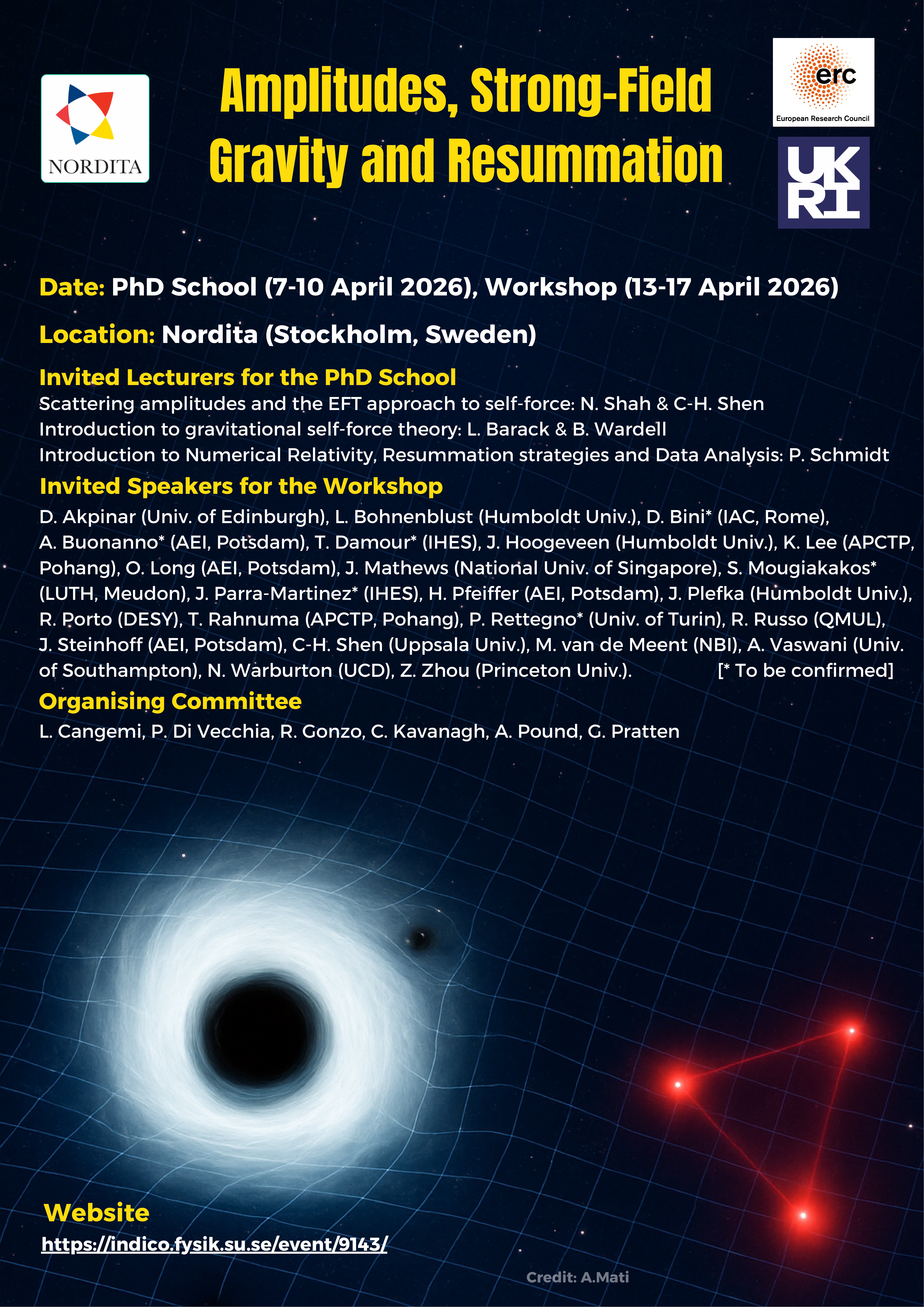
Workshop Poster
Click to view full poster (PDF)

The program is structured as follows:

  • Week 1 [April 7–10, 2026 (4 days)]: The PhD school will focus on foundations and tools for gravitational self-force, amplitudes, self-force EFT, resummation strategies and data analysis relevant to waveform modelling. Theoretical lectures will be complemented by hands-on programming sessions and dedicated tutorials.

  • Week 2 [April 13–17, 2026 (5 days)]: Workshop focused on uniting the weak-field (PM) and strong-field (GSF) approaches to the two-body problem, as well resummation strategies relevant for gravitational-wave phenomenology. Individual talks will be complemented by discussion sessions to promote cross-community interaction and constructive debates.


PhD School (7-10 April 2026)

Topics will include:

1) Scattering amplitudes and the EFT approach to self-force

Lecturers: Nabha Shah (NBI) & Chia-Hsien Shen (Uppsala Univ. and NTU, Taiwan)


2) Introduction to gravitational self-force theory

Lecturers: Leor Barack (Univ. of Southampton) and Barry Wardell (UCD)


3) Introduction to Numerical Relativity, Resummation strategies and Data Analysis

Lecturer: Patricia Schmidt (Univ. of Birmingham)  and Geraint Pratten (Univ. of Birmingham)  


Workshop (13-17 April 2026)

There is pressing need for high-precision models of gravitational waveforms from binary black hole mergers, driven by the increasing sensitivity of gravitational-wave detectors. The central theme of this program is how to leverage particle physics methods when calculating processes relevant to gravitational-wave phenomenology. In particular, the workshop focuses on uniting two key perturbative approaches — post-Minkowskian (PM) theory, effective for weak-field, widely separated systems, and gravitational self-force (GSF) theory, suited to extreme-mass-ratio systems in strong fields. Crucial to combining these tools is understanding the resummation of the perturbative series. We aim to bring together both experts and younger theorists from these communities, fostering new collaborations and combining our efforts to address the pressing questions at the interface between these fields.

Invited speakers: [* To be confirmed]

D. Akpinar (University of Edinburgh), L. Bohnenblust (Humboldt University), C-H. Chang (NTU), T. Damour (IHES), A. Georgoudis (QMUL), J. Hoogeveen (Humboldt University), M. Khalaf (Hebrew University), D. Kosower (IphT), K. Lee (APCTP, Pohang), O. Long (AEI, Potsdam), J. Mathews (National University of Singapore), A. Nagar (INFN, Torino),  H. Pfeiffer (AEI, Potsdam), J. Plefka (Humboldt University), R. Porto (DESY), T. Rahnuma (APCTP, Pohang), P. Rettegno (INFN, Torino), R. Russo (QMUL), J. Steinhoff (AEI, Potsdam), C-H. Shen (Uppsala University), M. van de Meent (NBI), A. Vaswani (University of Southampton), N. Warburton (UCD).


Venue

The program will be hosted by Nordita in Stockholm (Sweden) from 7th - 17th April 2026. 


Application/Registration

Due to limited space, registration will be moderated for both the PhD school and the workshop. You may apply to the PhD school only, the workshop only, or both. Registration to be considered for on-site participation will close on 31 January 2026; after this date, registrants will receive an on-site/remote participation confirmation from the organizers.

Remote participation: All talks will be livestreamed via Zoom, and recordings will be made available to registered participants who cannot attend in person.


Organizers

  • Lucile Cangemi — University of Edinburgh, United Kingdom

  • Paolo Di Vecchia — Nordita, Sweden

  • Riccardo Gonzo — Queen Mary University of London, United Kingdom

  • Chris Kavanagh — University College Dublin, Ireland

  • Adam Pound — University of Southampton, United Kingdom

  • Geraint Pratten — University of Birmingham, United Kingdom


Funding sources: 

This workshop is partially supported by the UKRI/ERC grant GWModels.


Sponsored by:


Registration
Application form
    • 09:00 09:30
      Registration
    • 09:30 11:00
      Amplitudes and EFT approach 1h 30m
      Speaker: Chia-Hsien Shen
    • 11:00 11:30
      Coffee break 30m
    • 11:30 13:00
      Intro to black hole perturbation theory and self-force 1h 30m
      Speaker: Leor Barack
    • 13:00 14:30
      Lunch 1h 30m
    • 14:30 16:00
      NR, EOB and Data Analysis 1h 30m
      Speaker: Patricia Schmidt
    • 16:00 17:00
      Free discussion 1h
    • 17:00 18:00
      Reception 1h
    • 09:30 11:00
      NR, EOB and Data Analysis 1h 30m
      Speaker: Geraint Pratten
    • 11:00 11:30
      Coffee break 30m
    • 11:30 13:00
      Amplitudes and EFT approach 1h 30m
      Speaker: Chia-Hsien Shen
    • 13:00 14:30
      Lunch 1h 30m
    • 14:30 15:30
      BHPT Tutorial 1h
      Speaker: Barry Wardell
    • 15:30 16:00
      Coffee break 30m
    • 16:00 17:00
      Gong Show
    • 09:30 11:00
      Intro to black hole perturbation theory and self-force 1h 30m
      Speaker: Leor Barack
    • 11:00 11:30
      Coffee break 30m
    • 11:30 13:00
      NR, EOB and Data Analysis 1h 30m
      Speaker: Patricia Schmidt
    • 13:00 14:30
      Lunch 1h 30m
    • 14:30 15:30
      Intro to self-force EFT 1h
      Speaker: Nabha Shah
    • 15:30 16:00
      Coffee break 30m
    • 16:00 17:30
      Intro to black hole perturbation theory and self-force 1h 30m
      Speaker: Leor Barack
    • 19:00 21:00
      Dinner Restaurang Kvarnen (Tjärhovsgatan 4, 116 21 Stockholm, Sweden) 2h
    • 09:30 11:30
      Intro to Self-force EFT 2h
      Speaker: Nabha Shah
    • 11:30 12:00
      Coffee break 30m
    • 12:00 13:00
      BHPT Tutorial 1h
      Speaker: Barry Wardell
    • 13:00 14:30
      Lunch 1h 30m
    • 14:30 16:00
      Hands-on session: NR, EOB and Data Analysis 1h 30m
      Speaker: Patricia Schmidt
    • 16:00 16:30
      Closing remarks and goodbye
    • 09:00 09:30
      Registration
    • 09:30 10:10
      High-Precision Dynamics and Waveforms in Two-Body Scattering 40m
      Speaker: Thibault Damour
    • 10:10 10:40
      Coffee Break 30m
    • 10:40 11:20
      Amplitudes for Gravitational Waves 40m

      I review relativistic perturbative computations relevant to gravitational-waves physics.

      Speaker: David Kosower
    • 11:20 12:00
      WEFT at fifth post N/M order 40m

      I review recent developments in the WEFT approach to compact binary dynamics, both in the PN and PM domains, to fifth order in the perturbative expansion.

      Speaker: Rafael Porto
    • 12:00 13:30
      Lunch 1h 30m
    • 13:30 14:10
      Numerical Simulations of Binary Black Hole Encounters 40m

      Binary black hole encounters are the general-relativisic
      generalization of the Newtonian two-body problem, and represent the
      majorit of observed gravitational waves (GW). Precise knowledge about
      the interaction between two black holes and the emitted GWs are of
      high importance for finding and analysing GW signals, as well as to
      deepen the understanding of the structure and solutions of Einstein's
      equations. Such knowledge is obtained by numerical calculations and
      perturbation methods like post-Newtonian and post-Minkowskian
      expansions, as well as the gravitational self-force formalism, and the
      last years have seen rich new results in the overlap between different
      methods. This talk summarizes recent advances in numerical relativity
      for binary black holes on eccentric and hyperbolic orbits, and for
      high mass-ratio. It then elucidates how numerical relativity and
      perturbation methods combine in the quest to understand properties of
      general relativity and to support gravitational wave science.

      Speaker: Harald Pfeiffer
    • 14:10 14:40
      Coffee Break 30m
    • 14:40 16:10
      Discussion session 1h 30m
      Speaker: Jan Plefka
    • 17:00 18:00
      Reception 1h
    • 09:30 10:10
      Gravitational radiation from hyperbolic orbits: comparison between SF, PM, PN and NR 40m

      In this talk will present the latest gravitational self-force (GSF) calculations for the radiation from hyperbolic orbits. In the first part of the talk I will focus on the radiated energy and comparisons with post-Minkowskian (PM), post-Newtonian and numerical relativity results as described in arXiv:2512.02274. In the secondary part I will present preliminary results for the radiated angular momentum and the gravitational wave memory.

      Speaker: Niels Warburton
    • 10:10 10:40
      Coffee Break 30m
    • 10:40 11:20
      Hybrid Self-Force and Post-Newtonian Waveform models - an opportunity for Post-Minkowskian Theory? 40m

      In this talk, I’ll give an overview of self-force-based hybrid gravitational wave models that incorporate results from post-Newtonian theory. I’ll highlight that the hybridisation procedure is carefully designed with intuition from common resummations in post-Newtonian and post-Minkowskian theory. I’ll conclude with a sketch of the opportunity for these hybrid models to incorporate scattering results from post-Minkowskian theory.

      Speaker: Josh Mathews
    • 11:20 12:00
      Post-Minkowskian theory, Numerical Relativity and Effective-One-Body models 40m

      The analysis of gravitational-wave events requires fast and accurate theoretical predictions. I focus on Effective-One-Body (EOB) models informed by Post-Minkowskian (PM) results and Numerical Relativity (NR) simulations. I compare analytical and numerical results for binary scatterings, including spin and tidal effects. Finally, I discuss the use of PM results for bound systems by means of a Lagrangian formalism.

      Speaker: Piero Rettegno (Polytechnic University of Turin)
    • 12:00 13:30
      Lunch 1h 30m
    • 13:30 14:10
      Perturbative QFT for Gravitational Waves: Nonlocal-in-time dynamics @ 5PM 40m

      In recent years, techniques from perturbative quantum field theory have driven significant progress in the Post-Minkowskian (PM) expansion of binary black hole dynamics. A key challenge in this framework arises from conservative, nonlocal-in-time contributions, which obstruct a straightforward analytic continuation from scattering states to bound orbits via the boundary-to-bound (B2B) dictionary. In this talk, I will present a practical resolution based on a hybrid subtract-and-add scheme that consistently combines PM, Post-Newtonian (PN), and self-force (SF) results. This approach enables the controlled treatment of nonlocal effects and yields new state-of-the-art results for the conservative dynamics at 5PM order, including contributions up to 10th order in the self-force expansion.

      Speaker: Gregor Kälin
    • 14:10 14:40
      Coffee Break 30m
    • 14:40 16:10
      Discussion session 1h 30m
      Speaker: Jan Steinhoff
    • 16:30 18:00
      Poster session 1h 30m
    • 09:30 10:10
      When eccentricities "tick up'' 40m

      The dissipation of energy and angular momentum through the emission of gravitational waves dampens the eccentricity of compact binaries. This is a well-known fact in gravitational wave theory. However, there is a notable well-documented exception to this rule: in extreme mass-ratio inspirals the eccentricity will initially decrease during the inspiral, but will ``tick-up'' just before the binary transitions to its final plunge. We here give a simple explanation for this behaviour, showing that this the expected universal behaviour for eccentric systems transitioning through a last stable orbit.

      Speaker: Maarten van de Meent
    • 10:10 10:40
      Coffee Break 30m
    • 10:40 11:20
      Modelling black hole scattering using comoving hyperboloidal coordinates 40m

      In recent years, the gravitational wave community has seen growing
      interest in modelling scattering events between 2 black holes (BH) since such
      events serve to better probe regions of strong gravity close to the primary BH.
      While some progress on this has been made using the post-Minkowskian
      approximation using techniques from effective field theory and scattering
      amplitudes, a complimentary approach is to use the Gravitational Self Force (GSF)
      which is more suited to analysing motion in the strong field. In this talk, I describe
      how these events can be modelled for self-force applications using a numerical
      scheme based on hyperboloidal slices that are comoving with the smaller particle.
      Furthermore, I will show how this scheme circumvents the divergences that
      plagued earlier time-domain implementations.

      Speaker: Aditya Vaswani
    • 11:20 12:00
      Black hole scattering in the strong-field regime: Merging post-Minkowskian theory with numerical methods 40m

      Recent advances in modelling unbound binary black hole interactions have been driven by the application of scattering amplitude methods to generate results within the post-Minkowskian (PM) expansion. However, this expansion breaks down when approaching the strong-field regime, where large curvature effects become non-negligible. In this talk, I will show how data from numerical relativity simulations and self-force (SF) calculations can be used as benchmarks to validate state-of-the-art PM expressions. Additionally, I will show how strong-field SF information can be used to resum the PM series, providing accurate predictions for scattering angles and radiative quantities across all separations.

      Speaker: Oliver Long
    • 12:00 12:10
      Group picture
    • 12:10 13:30
      Lunch 1h 20m
    • 13:30 14:10
      Waveform modeling within the effective one body approach: new perspectives 40m

      I will briefly summarize the status of effective-one-body (EOB) based waveforms for generic binaries (spin precession, eccentricity, scattering) and then suggest new avenues for theoretical development coming from both the post-Minkowskian approach and from (revisited) black hole perturbation theory.

      Speaker: Alessandro Nagar
    • 14:10 14:40
      Coffee Break 30m
    • 14:40 16:10
      Discussion session (Chris Kavanagh) 1h 30m
    • 19:00 21:00
      Dinner Restaurang Kvarnen (Tjärhovsgatan 4, 116 21 Stockholm, Sweden) 2h
    • 09:30 10:10
      Dissipative observables for black hole scattering 40m

      I will use Black Hole Perturbation Theory (BHPT) to study dissipative observables such as the radiative and absorbed fluxes of energy and angular momentum. I will focus on the case of black hole scattering in the Post-Minkowskian regime and discuss to what extent it
      is possible to reconstruct the full observables from the BHPT expansion.

      Speaker: Rodolfo Russo
    • 10:10 10:40
      Coffee Break 30m
    • 10:40 11:20
      Surfing the shockwave with black hole response theory 40m

      In this talk, we develop a black-hole response formulation of worldline quantum field theory (WQFT) tailored to the gravitational self-force (SF) expansion. By integrating out the primary black hole’s worldline and graviton fluctuations, we obtain an effective action built from black-hole response functions. In this, the one-point response function encodes the exact background metric, the two-point response function describes the scattering of a gravitational wave off the black hole, and higher-point functions provide effective vertices for a systematic gravitational SF expansion.
      As a first application, we consider a massless primary source, corresponding to the Aichelburg-Sexl shockwave or an ultra-boosted black hole. We show that the one-point response resums to the exact shockwave metric. Next, we discuss the computation of the exact in G two-point response by resumming the full post-Minkowskian series. We conclude with an outlook on how to obtain the 1SF impulse and waveform in the high-energy regime with this framework.

      Speaker: Lara Bohnenblust
    • 11:20 12:00
      Non linear memory from reverse unitarity 40m

      I will present a recent computation of the nonlinear gravitational-wave memory in two-body scattering, using scattering amplitudes and soft theorems in the weak-field post-Minkowskian regime. The effect first appears at NNLO PM, and I will show how its evaluation reduces to simpler, lower-point cut two-loop integrals.

      Speaker: Alessandro Georgoudis
    • 12:00 13:30
      Lunch 1h 30m
    • 13:30 14:10
      Gravitational Sommerfeld Effects 40m

      In the effective field theory (EFT) description of compact binary inspirals, the radiated gravitational waveform receives universal corrections from gravitational background, the so-called "tail" effects, that resum into the "Sommerfeld factor". We derive a closed-form expression for the Sommerfeld factor and present a systematic framework to compute it at high orders by combining EFT with black hole perturbation theory, including induced tidal responses. We prove that the phase of the Sommerfeld factor is exactly half of the elastic Compton scattering phase shift when tidal interactions are conservative. We further establish a new renormalization group equation for the radiative multipole moments. These high-order perturbative results provide new avenues for improving waveform resummation.

      Speaker: Chih-Hao Chang
    • 14:10 14:40
      Coffee Break 30m
    • 14:40 16:10
      Discussion session (Chia-Hsien Shen) 1h 30m
    • 09:30 10:10
      Self-Force From Response Theory 40m

      We develop an efficient framework for the computation of gravitational Self-Force (SF) dynamics with Worldline Quantum Field Theory (WQFT). This “response theory” constructs an effective action for the self-forced secondary, expanded in terms of response functions. These response functions encode all SF dynamics and are interpreted as classical off-shell n-point graviton correlation functions. We discuss in length how SF dynamics may be obtained from response functions, when supplemented by 0SF dynamics. The framework is then explicitly applied to gravitational scattering in the Aichelburg-Sexl background describing a massless black hole. The prerequisite 0SF dynamics is explicitly computed, and promising work towards 1SF discussed.

      Speaker: Jitze Hoogeveen
    • 10:10 10:40
      Coffee Break 30m
    • 10:40 11:20
      Kerr Black Hole Scattering: An On-Shell Approach to Conserved Quantities and Integrability 40m

      Amplitudes and worldline methods have emerged as powerful tools for studying the gravitational two-body problem. In particular, they have enabled major progress in the computation of scattering observables for spinning black holes at high post-Minkowskian orders. In this talk, we will build on these developments to investigate the integrability properties of Kerr black hole scattering, both in the probe limit and beyond. We will begin by reviewing the radial action and the recently introduced Dirac bracket formalism, which together motivate a notion of asymptotic integrability. Using these tools, we will show that this integrability persists to higher orders in spin than previously established. Finally, we will discuss spin-shift symmetry, a striking and still not fully understood property of spinning amplitudes, and show how, when combined with integrability constraints, it leads to a powerful bootstrap of the radial action.

      Speaker: Dogan Akpinar
    • 11:20 12:00
      Analytical Fluxes from Generic Schwarzschild Geodesics 40m

      In this talk, I present an analytic method for computing gravitational-wave fluxes from bound Schwarzschild geodesics with arbitrary eccentricity. Our approach systematically expands the Fourier coefficients of the emitted radiation in a Chebyshev basis, allowing them to be reduced to sums of Keplerian-like Fourier coefficients previously derived in the Quantum Spectral Method. Because the construction does not rely on a small-eccentricity expansion, it applies to a broad range of bound eccentric orbits. As an illustration, we implement the method using a 15PN-expanded input and find that it reproduces the total flux for the validation case (p,e)=(12.5,0.5) to relative accuracy 10^{-5}, while for the stronger-field orbit (p,e)=(10,0.8) it yields weighted mode-by-mode errors below 10^{-6} for the selected dominant modes analyzed. These results provide an analytic route to frequency-domain flux calculations relevant to EMRI modelling.

      Speaker: Majed Khalaf
    • 12:00 13:30
      Lunch 1h 30m
    • 13:30 14:10
      Metric of a Star: A Recursive multipolar Post-Minkowskian Construction 40m

      We construct the exterior metric of a stationary compact source within the multipolar post-Minkowskian (MPM) formalism and develop a recursive momentum-space reformulation of the construction. The MPM framework solves the Einstein equations outside a compact source perturbatively in Newton's constant, decomposing the metric into symmetric trace-free mass and current multipole moments. In this momentum space, the multipolar structure emerges naturally from the recursive field equations, simplifying tensor structures and clarifying how multipole moments enter at successive PM orders. Crucially, the nonlinearities of the Einstein equations reduce in this picture to the iterative evaluation of bubble integrals, making explicit the nonlinear multipolar interactions, including monopole–quadrupole, quadrupole-quadrupole, and higher-order couplings. As a consistency check, we match the generic multipolar solution to the Kerr metric generated independently by a similar recursive formulation, verifying that the construction reproduces the correct Kerr multipole structure, which includes its infinite tower of moments, and thus captures the nonlinear structure of rotating vacuum solutions.

      Speaker: Tabasum Rahnuma
    • 14:10 15:40
      Discussion session (Kanghoon Lee) 1h 30m
    • 15:40 16:10
      Closing remarks and goodbye